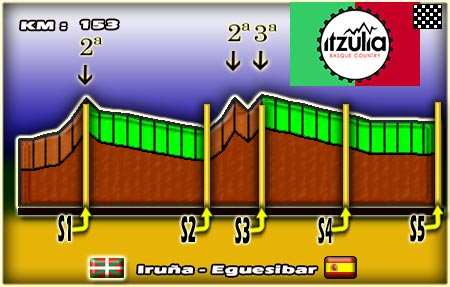
General info(= my point of view), so it is not really a reaction to Rico, because he is very experienced and knows the info below :
section 3 in the picture = a combi-section of climb ánd hills.
Always the case when you see such a brown climb section with a 3"category or 4"category in it. Because :
4" and 3" = hills
2" and 1" and E" = mountains.
What counts in every section = race GV + "underground".
( the race GV is of more influence in a section, how much more than "underground" is unknown )
Hills gets a very low percentage in the race GV, but for sure counts in s3 due to the 3"category hill,
although in s3 "underground"hills counts a little less than "underground" climb, because a climb is "heavier" than a hill.
The ranking of "heavy" and "light" sections =
1. climb
2. hills & cobblehills
3. flat-cobble
- - - - - - - - - - - (
a dot line to show that the 3 above are much heavier than the 2 below )
4. flat
5. downhill
The heavier a section is, the more effective the used energy is. What is also the case in real cycling.
For example ;
Dumoulin makes a training ride and the track is one section upmountain and one section downhill.
He has a total of 4 EP for both sections.
The first time he decides to use 1 EP in s1 (= mountain ) and 3 EP in s2 (= downhill ), and he finishes after 55 minutes.
The next day the same training ride, now 4 EP in 1 and 0 EP in s2, and he finishes already after 30 minutes.
25 minutes faster with the same total amount of energy used.
This has everything to do with that using energy in the mountains is much more effective than using energy in downhill.
In other words ; a climb section is the "most heavy" section, and a downhill section is the "lightest" section.
Therefore such a combi climb+hills section 3 as in the race picture of Itzulia stage 2, is a tiny little "lighter" than a real mountain section.
Upmountain sections are the heaviest, because there is no downhill in it.
(
of course, downhill can count in a upmountain section, if it is in the race GV, because per section it is always = race GV + underground )
And the category is often also of influence in how "heavy" a section is. ( sometimes not, I guess the software maker was lazy then )
An E" category is more heavy than a 2" category mountain, and therefore using energy is more effective on a E"category mountain,
although it depends on where the mountains are in a track, and also it depends on if a mountain section has downhill in it or not.
There are more of such combi-sections(climb+hills) this season ;
s3 of stage 4, Tour de Suisse
s2 of stage 4, Tour de France
s2 of stage 8, Tour de France
For example s2 of stage 4 TdF, there the 4" hill is of almost no influence,
because in the underground climb counts more + in the race GV climb counts a lot.
A climb teamcaptain without a hill skill does not have to adjust the tactics in s2, the 4"hill is no worry, his "section-GV" is good enough.
However, to climbers with no hill skill and who are riding in a helper's role, s2 might be tricky due to the 4"hill in it.
And there are more combi sections in this game, for example all flat sections with a "hidden" hill in it.
And also not "hidden" hills in a flat section, such as s5 of MilanoSanremo ; those two 4"cat.hills are the Cipressa and the Poggio.
For sure hills&dh count too in the underground of s5 in MSR, the hill-skill even a lot. On top of that, hills is in the race GV as well.


